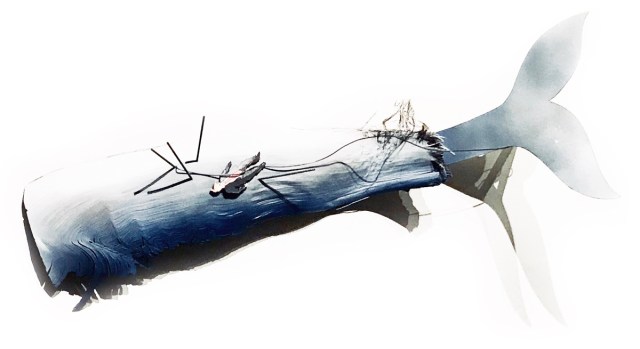
below: Ahab’s Demise, 2018, Mixed media object, length 25″
The 2018 installment of the Pequod Mutiny, comprised of paintings, graphics and objects, differs from the 2015 version because our current President is Donald Trump, who shares certain unfortunate traits with Melville’s Captain Ahab.
The current version of Pequod Mutiny has been on display at Bolivar Cafe Gallery during the months of August through October 2018.
Cafe Bolivar, 1741 Ocean Park Blvd., Santa Monica, CA
below: Ahab’s Demise, 2018, Mixed media object, length 25″
Artist Statement
Moby-Dick is a great American novel because in its closely observed soundings of Ahab’s archetypal wounds; in the overt symbolism of the ship as hunting party, abattoir and roving industrial juggernaut; in the polyglot confederation of its crew and in its closely observed soundings of Ahab’s archetypal wounds; in the polyglot confederation of its crew and in its absence of women, we encounter a faceted critique of America as we moved rapidly from an agrarian, mercantile republic to a globe girdling industrial empire.
Closely observed process often serves as metaphor or prophecy. Melville’s masterwork was not well received in his lifetime, but later generations of readers and critics have rightly ascribed to it a prescience as the nation has lurched from one willfully self-inflicted crisis to another.
Harvesting blubber for lamp oil and lubricant, a quintessential 19th century enterprise, brought whales to the brink of extinction, just as other forms of acquisition and harvest doomed other species and peoples. Melville’s modeling of the rapidly expanding domains and purposes of the American experiment illustrated the cost of our “red in tooth and claw” natures and the dangers of belief systems and egoism due to their disconnection from reality and basic human sympathy.
The expansion phases of large scale human endeavor typically come at such a gruesome price that the costs are at once denied and lionized as virtue: having been in the ascendant, and believing God has chosen us to be exceptional, many Americans enjoy a comforting romantic self-regard. Polemicists and apologists treat early phases of empire or nation building as heroic. Conservatives, mistakenly thinking that history repeats itself (when, pardon the cliche, it merely rhymes) hark back to the formative days and prescribe its simplicity, generative beliefs, ambitions, racism and criminality as formulas for regeneration.
Liberals, with their tendency to compromise, would encourage the substitution of benign ambition for blind. Starbuck attempted consensus building to change to a sustainable course, but Ahab’s grievance-fueled theatrics and fire eating woo-woo won the crew.
Moby-Dick is a great American novel because in its closely observed soundings of Ahab’s archetypal wounds; in the overt symbolism of the ship as hunting party, abattoir and roving industrial juggernaut; in the polyglot confederation of its crew: in its closely observed soundings of Ahab’s archetypal wounds and in its absence of women, we encounter a faceted critique of America as we moved rapidly from an agrarian, mercantile republic to a globe girdling industrial empire.
Closely observed process often serves as metaphor or prophecy. Melville’s masterwork was not well received in his lifetime, but later generations of readers and critics have rightly ascribed to it a prescience as the nation has lurched from one willfully self-inflicted crisis to another.
Harvesting blubber for lamp oil and lubricant, a quintessential 19th century enterprise, brought whales to the brink of extinction, just as other forms of acquisition and harvest doomed other species and peoples. Melville’s modeling of the rapidly expanding domains and purposes of the American experiment illustrated the cost of our “red in tooth and claw” natures and the dangers of belief systems and egoism due to their disconnection from reality and basic human sympathy.
The expansion phases of large scale human endeavor typically come at such a gruesome price that the costs are at once denied and lionized as virtue: having been in the ascendant, and believing God has chosen us to be exceptional, many Americans enjoy a comforting romantic self-regard. Polemicists and apologists treat early phases of empire or nation building as heroic. Conservatives, mistakenly thinking that history repeats itself (when, pardon the cliche, it merely rhymes) hark back to the formative days and prescribe its simplicity, generative beliefs, ambitions, racism and criminality as formulas for regeneration.
Liberals, with their tendency to compromise, would encourage the substitution of benign ambition for blind. Starbuck attempted consensus building to change to a sustainable course, but Ahab’s grievance-fueled theatrics and fire eating woo-woo won the crew.
Grievance becomes us. Killer celebrity G.A. Custer might have become president if his cartoonish vanity had not brought him up against injured forces of nature who, like the white whale or the Lakota Sioux, weren’t having it –at least not on that day. Americans, most of whom explicitly supported the genocide, might have eventually brought his narcissistic swagger into the White House had he only listened to his scouts’ intelligence, and saved himself.
Fear and avarice are a nasty combination. Likewise, the Pequod’s crew would have lived to reunite with their families if Ahab had listened to Starbuck, or perhaps more to the point, had Starbuck succeeded in convincing them to overthrow their deranged leader.
We’re faced with a revisioning that manages and reweaves our social and economic fabric, enhances human freedom and restores the systems that sustain us. Presently alienated from ourselves and each other, the capacity for this sort of healing connectivity seems to be evading us.
Ahab’s angry wounds personify this break from nature and ourselves. While nature often seems to generate chaos and wretched excess in the short run, in the larger view she has systems management to attend to. And so do we.
Unlike the hapless Pequod crew, we’ll need to achieve an empathetic peace with the environment and ourselves to avoid a date with our own Leviathan of wrathful consequence.
Joe Phelan
August, 2018
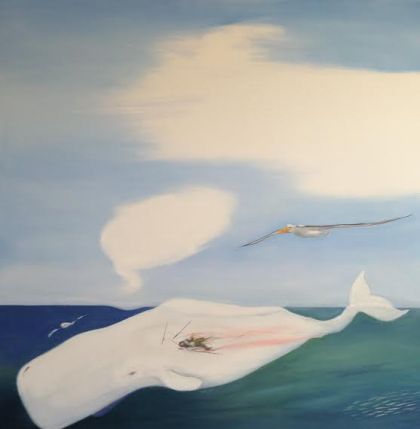
Albatross 2015, 48 x 48, oil on canvas Below: detail

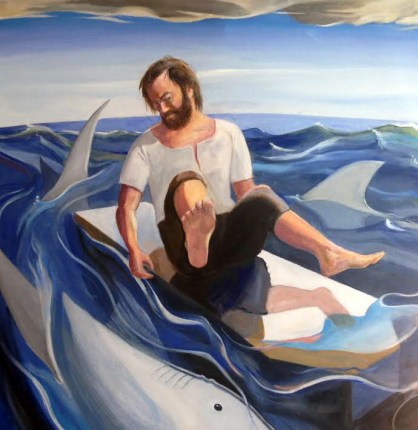
Ishmael and the Sharks, 2015, 24″ x 24″ oil on canvas
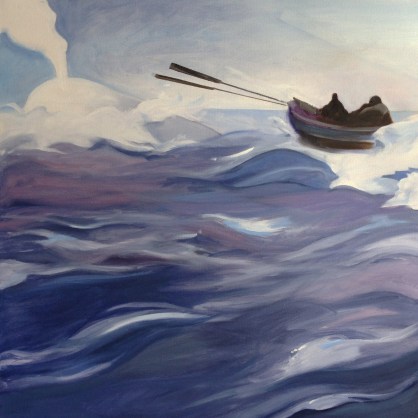
Chasing, 2015, 24″ x 24″ oil on canvas
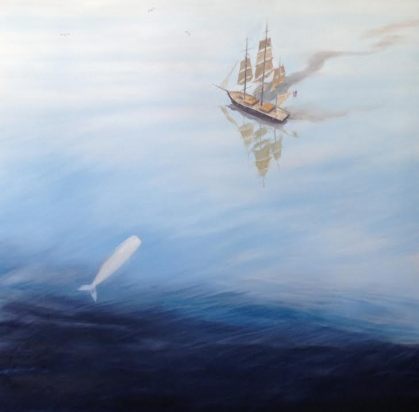
Denouement, 2015, 48″ x 48″ oil on canvas
 Joe Phelan Projects